

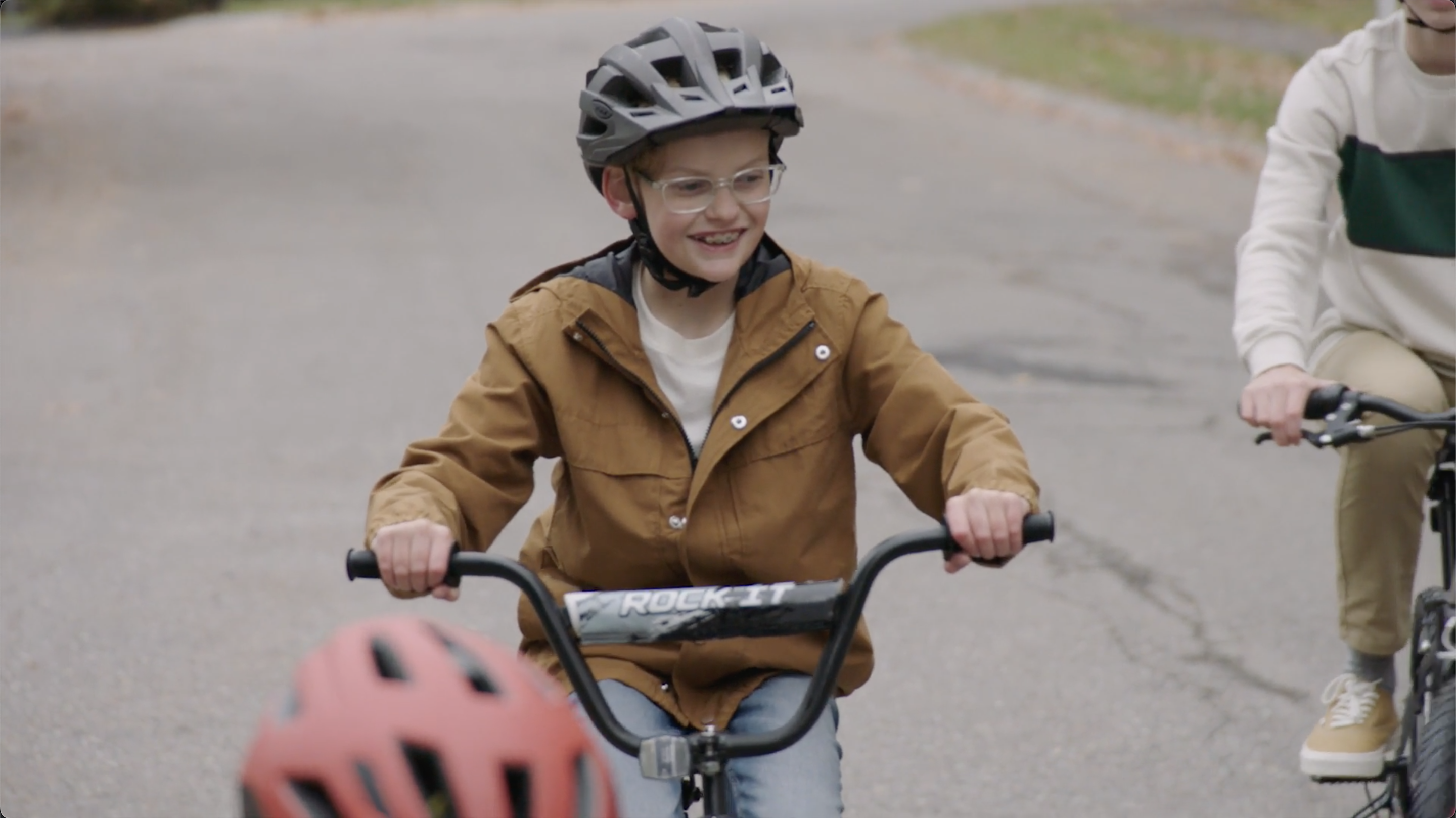
Speaker 1: [00:00:16] Mom, this is [unintelligible 00:00:16].
Terisa Bianchi: Okay. Perfect. My name is Terisa. I have 3 boys. The oldest, Brian, is 14, Tyler is 10, and Benny is 5. [00:00:30] I think that being a mom is probably what my calling's been. I love being their mom. I love being just involved with raising them. It's what I've always wanted to do. I've always wanted to have kids. I didn't really know what I wanted to do with work. I just knew I wanted my job to be being a mom.
The most rewarding thing is just watching them grow up, just seeing their different personalities. They're so unique. They all have their own character traits, their own interests. Tyler's hobbies are swimming, [00:01:00] playing basketball, throwing the ball around with his brothers. He likes to do that. He likes to cook with me. We like to just hang out, and watch movies and videos. He loves video games. That's his favorite thing right there.
When I was pregnant with Tyler, they did a very thorough check, the 18-week fetal survey, just to be proactive since I was born with a heart condition. That's when they found the hole in his heart and some issues. They diagnosed him [00:01:30] prenatally with tetralogy of fallot. He was born at 39 weeks, and everything looked good. They took an X-ray of his heart, and that's when I saw the butterfly vertebrae, which is now knowing that that's the first marker that we found for Alagille syndrome. Then he went home, and we were looking forward to surgery day, and that was it.
He started getting really jaundiced, even though he was eating really well. The pediatrician had just run some basic bilirubin tests. He was [00:02:00] really high, but he didn't think it was dangerously high to send him to the hospitals. We were going back and forth between cardiology for a week, and then pediatrician for a week just to make sure his heart was stable until he was ready for surgery.
The morning of pre-op, they just threw on a liver function panel test just to see if the bilirubin dropped. Next thing you know, surgery's canceled, and he's whisked upstairs for a liver ultrasound. Then that's where they were able to diagnose the bile duct paucity. [00:02:30] They went right from there and clinically diagnosed him with Alagille syndrome.
[music]
When he was diagnosed with Alagille syndrome, I just remember standing there and everything spinning [00:03:00] around me. I just felt like I was in this tornado of, like, "What? This just happened to me? I just did everything you told me to do, and now I have this diagnosis.” The light in the tunnel there was finding the Alagille support page, and finding people that were going through exactly what I was going through, and being able to also connect with families that had the same age child as my kid. It was great to see adults, [00:03:30] and say, "Wow, these kids have a future." Ironically, it felt very comforting to have someone on my side.
[music]
Learning about bile acids through the Alagille support page, I realized that that was a big factor to his itch. Basically, your liver has no natural flow of the bile, so it just reabsorbs and it's going through your bloodstream. Everywhere your blood is, from head to toe, [00:04:00] is going to be itchy. I started noticing him rubbing his eyes a ton. It was more than just the hunger cues, more than the tired cues. We went back into another pediatrician and asked, "What's going on?" They said, "No, it's not allergies. He's got to go through a whole season before it's diagnosed with allergies." It was just kind of brushed off as, we don't know what that is.
The itch was getting worse. Every time we did a diaper change, he was scratching at his legs or his diaper area, and then [00:04:30] rubbing the eyes constantly. That was the big thing for him. Then it moved into putting toddler socks on his hands so that they went all the way up to his arms. That way, at night, he wasn't digging into his ears and making them bleed everywhere. The itch normalized for us. We just knew it was there, but at the same time, we really discredited a lot of the itch and a lot of the liver involvement to just being mild, even though we later learned that it was [00:05:00] much more severe than mild.
It just was changing bed sheets consistently, bandaging up all the cuts. Unfortunately, grieving the fact that I couldn't do the bed sharing and the cuddling with Tyler because he just sweat so much. Then it made him more itchy. Then trying to sleep with him, he was tossing and turning and rolling and scratching. I was like, "I can't do this. I'm not sleeping. He's not sleeping." Naps were few and far between. He just was never settled for nap time because he was so itchy, and there was no medication [00:05:30] out there at the time for Tyler to take that actually worked for him to relieve that itch.
Tyler Bianchi: The itch is just bad. It's horrible and it keeps me from doing stuff. The itch just feels like an itch, like a bug bite or something. Then you go and it goes from here to your back, and it goes all over and then you can't stop.
[music]
[00:06:00]
Terisa: We had learned that LIVMARLI was getting close to being FDA approved, and we were very excited about something being an option for him again. We worked with our doctor, and [00:06:30] got him on LIVMARLI. Tyler was a good candidate for LIVMARLI because he had Alagille syndrome, but then he had that very persistent pruritus. When he turned 10, he started LIVMARLI, and that was great. It was a really fun day for him because it was his birthday, but also it was the start of what could be his new normal, not itching as much as he had been.
On his 10th day was when we started realizing he's sleeping through the night. He's not tossing and turning. [00:07:00] There had been no new scabs, no bandages on his arms and legs. That was a sight to see, to not have the bandages so much, but then also just to see him sleeping, and his brothers sleeping because they all shared a room, and they weren't being woken up by him tossing and turning so much.
Once his doctor prescribed LIVMARLI, we got connected with the Mirum Access Plus program, and they got it right on our doorstep in less than 2 months. It's been nice to not have to be chasing down doctors [00:07:30] for refills and going to the pharmacy to pick things up. It's just so convenient having it right to our door.
One side effect that we've been battling is of GI cramping. That's just something that we knew it was a possibility of this happening. We had to work with our doctor to make sure that we could manage this for him and let it be so that he could still attend school and do his daily activities. [00:08:00] I think he's great now. We're going strong on 10 months. What do you think?
Tyler: I think we're doing good.
Terisa: You feel good on the medicine?
Tyler: Yes.
Terisa: I know 10 years is a long time, but I'm glad he wasn't 20 and he just got his hands on this. I wish it could have been sooner for him, but I'll take 10 years and then the rest of his life.
Tyler: Having Alagille syndrome doesn't really make me feel much [00:08:30] different. It just makes me feel like myself because it doesn't affect what's on the outside. It mostly affects what's on the inside. Now that I'm on LIVMARLI, I'm itching less and I'm sleeping better.
Terisa: There's people out there that are willing to connect, and happy to connect, and make sure that you feel supported through your journey because the beginning, it can be very overwhelming and you can feel like you're drowning, but there's light on the other side, and there's [00:09:00] possibility of having happiness as part of your everyday.
Speaker 2:
INDICATIONS
LIVMARLI (maralixibat) oral solution and tablets are indicated for the treatment of cholestatic pruritus in patients who are 3 months of age and older with Alagille syndrome.
LIVMARLI (maralixibat) oral solution and tablets are indicated for the treatment of cholestatic pruritus in patients who are 12 months of age and older with progressive familial intrahepatic cholestasis (PFIC). [00:09:30]
Limitations of Use: LIVMARLI is not recommended in a subgroup of PFIC type 2 patients with specific ABCB11 variants resulting in nonfunctional or complete absence of bile salt export pump (BSEP) protein.
IMPORTANT SAFETY INFORMATION
CONTRAINDICATIONS
LIVMARLI (maralixibat) oral solution and tablets are contraindicated in patients with prior or active hepatic decompensation events (eg, variceal hemorrhage, ascites, or hepatic [00:10:00] encephalopathy).
WARNINGS AND PRECAUTIONS
Hepatotoxicity: LIVMARLI treatment is associated with a potential for drug-induced liver injury (DILI). In the PFIC trial, treatment-emergent hepatic decompensation events and elevations of liver tests or worsening of liver tests occurred. Two patients experienced DILI attributable to LIVMARLI. Two additional patients experienced DILI in the open-label extension portion of the trial. Of these 4 patients, 1 patient required liver transplant and another patient died. [00:10:30]
In the Alagille syndrome trial, treatment-emergent elevations of liver tests or worsening of liver tests occurred.
Obtain baseline liver tests and monitor during treatment. Liver-related adverse reactions and physical signs of hepatic decompensation should also be monitored. Dose reduction or treatment interruption may be considered if abnormalities [00:12:30] occur in the absence of other causes. For persistent or recurrent liver test abnormalities, consider treatment discontinuation. Permanently discontinue LIVMARLI if a patient experiences [00:11:00] the following: persistent or recurrent liver test abnormalities, clinical hepatitis, or a hepatic decompensation event.
Gastrointestinal Adverse Reactions: Diarrhea and abdominal pain were reported as the most common adverse reactions. Monitor for dehydration and treat promptly. Consider reducing the dosage or interrupting LIVMARLI treatment if a patient experiences persistent diarrhea or diarrhea with bloody stool, vomiting, dehydration requiring treatment, or fever.
Fat-Soluble Vitamin [00:11:30] (FSV) Deficiency: Patients can have FSV deficiency (vitamins A, D, E, and K) at baseline, and LIVMARLI may adversely affect absorption of FSVs. Treatment-emergent bone fracture events have been observed more frequently with patients treated with LIVMARLI compared with patients treated with placebo. If bone fractures or bleeding occurs, consider interrupting LIVMARLI and supplement with FSVs. LIVMARLI can be restarted once FSV deficiency is corrected and maintained at corrected levels.
Risk of Propylene [00:12:00] Glycol Toxicity (Pediatric Patients Less Than 5 Years of Age): LIVMARLI oral solution contains propylene glycol. Total daily intake of propylene glycol should be considered for managing the risk of propylene glycol toxicity. Monitor patients for signs of propylene glycol toxicity. Discontinue LIVMARLI if toxicity is suspected.
ADVERSE REACTIONS
Alagille syndrome: The most common adverse reactions are diarrhea, abdominal pain, vomiting, FSV deficiency, [00:12:30] liver test abnormalities, and bone fractures.
PFIC: The most common adverse reactions are diarrhea, FSV deficiency, abdominal pain, liver test abnormalities, hematochezia, and bone fractures.
DRUG INTERACTIONS
Administer LIVMARLI at least 4 hours before or 4 hours after administration of bile acid binding resins.
A decrease in the absorption of OATP2B1 substrates (eg, statins) due to OATP2B1 inhibition [00:13:00] by LIVMARLI in the GI tract cannot be ruled out. Consider monitoring the drug effects of OATP2B1 substrates as needed.
DOSING INFORMATION
In patients with Alagille syndrome, LIVMARLI is taken once daily, 30 minutes before a meal in the morning. In patients with PFIC, LIVMARLI is taken twice daily, 30 minutes before a meal. Refer to the dosing by weight guidelines and the full Prescribing Information for complete details on dosing for the oral solution and tablet formulations. [00:13:30] The provided oral solution dosing dispenser must be used to accurately measure the dose. Any remaining LIVMARLI oral solution should be discarded 100 days after first opening the bottle. LIVMARLI tablets can be used in patients weighing ≥25 kg who can swallow tablets.
Please see full Prescribing Information for LIVMARLI at LIVMARLIhcp.com.
[00:14:00] [music]
[00:14:19] [END OF AUDIO]


Video library
Meet real physicians and families who share their experiences and offer their perspectives on everything from diagnosis to treatment with LIVMARLI.

Proven pruritus relief
See how LIVMARLI helps relieve cholestatic pruritus in Alagille syndrome and progressive familial intrahepatic cholestasis.1-3